


Article summary
If your SIP devices work in the lab but fall apart across real locations, the problem is usually endpoint management, not the hardware.
-
SIP was built for call setup and signaling, not centralized endpoint management at scale.
-
Global deployments add real-world friction: time zones, firewall rules, WAN jitter, and “who changed that setting?” moments.
-
Manual management breaks down fast: config drift, firmware mismatch, and slow troubleshooting.
-
Centralized endpoint management gives you visibility, consistency, and fewer “it stopped working” tickets.
-
A modern approach pairs proven hardware with a centralized platform like endpoint management to keep global SIP fleets under control.
A Story You’ve Lived: The Perfect Lab Test Trap
You finally get to relax and breathe now that the hard part of trying to choose the right products is safely behind you. The next step is testing and configuring devices, which is secretly your favorite part. In the lab, your SIP endpoint registers instantly; step one is a success. Then, you test paging, and talkback, and have two more green lights. You don’t stop there and decide to reboot the test units a few times for good luck. All is working, and so far, no issues.
With your testing and documentation now complete, you ship 200 devices to 30 sites over a six-week period. After all the units have been received and installed, a communication channel is established to help work out any wrinkles:
Week 1: All good with no issues to report
Week 3: One site reports, “Paging is dead.”
Week 4: Another site says, “It works. . .sometimes.”
Week 6: Someone asks, “Are we sure we updated the firmware everywhere?”
And that’s when the truth shows up and hits you like a ton of bricks: your SIP endpoints didn’t fail; your endpoint management did. To be clear, you and your team aren’t sloppy, but it’s because manual device management doesn’t scale.
Keep reading, and we’ll dive into how to fix the dizzying world of endpoint management.

What Is a Session Initiation Protocol (SIP) IP Endpoint?
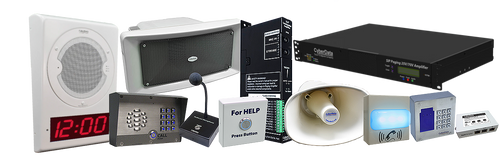
The technology behind business communication underwent a significant, positive shift with the emergence of the internet and SIP. A SIP endpoint is any device that uses SIP (Session Initiation Protocol) to register to a call server or PBX and participate in voice sessions.
That can include:
-
Paging speakers
-
Intercoms
-
Paging adapters/amplifiers
-
Alert buttons
-
Door stations
-
SIP phone
The SIP protocol itself is a signaling standard for creating and managing sessions, and it’s great at doing that. But on its own, SIP is not a built-in endpoint management system, and global deployments punish anyone who treats it like one.
The Real Problem: SIP Was Never Designed for Centralized Management or Modern Endpoint Management Policies
Here’s the key point: SIP defines how endpoints communicate for sessions, not how you manage thousands of endpoints as a living, connected unit. So, what tends to happen in the real world?
You build your own management system out of pieces:
-
A spreadsheet for MACs, IPs, and site names
-
A shared folder with “golden config” files
-
A ticketing queue that becomes your monitoring system
-
A few scripts that only one person understands and can deploy
-
VPN is the default for the troubleshooting plan
The reality is that it’s not a strategy; it’s a game of survival, and that survival is expensive.

Why These Patch Management and Endpoint Security Problems Multiply in Global Deployments
When you try to standardize and go global, your environment becomes less predictable. There’s no fear-mongering about it; that’s the day-in, day-out life of many IT departments.
Network conditions and proxy servers aren’t consistent
Voice and paging reliability can suffer when latency, jitter, or packet loss changes from site to site. Quality of Service (QoS) configuration is a major contributor to service issues with distributed deployments; get that locked down, and you’ll be thanking yourself later.
Firewalls and NAT get “creative”
One site has a clean SIP path, while another has a security appliance doing “helpful” things. Another site has a local rule someone added six months ago, and they’ve forgotten why.
Time zones slow down response
If your manufacturing site in Asia breaks at 2:00 a.m. Denver time, the needed quick fix becomes tomorrow’s fire drill.
Configuration drift creeps in
Small differences stack up over time: one endpoint got a manual tweak, another missed an update, another was replaced and reconfigured to work, but not perfectly. That’s configuration drift, and when systems gradually diverge from the intended standard state.
The Old Way: Manual SIP Endpoint Management
Manual SIP management has been the go-to because there weren’t many other viable alternatives. No finger-pointing needed, just recognizing the reality of the situation.
Here’s what the manual struggle usually looks like:
-
You find out something is broken because someone complains or reports an issue. The lack of visibility means no early warning.
-
Troubleshooting starts with guesswork: Is it registration? DHCP? DNS? VLAN? Firmware? Credentials? A new firewall rule?
-
Fixes are one-off: Someone logs in, changes a setting, and moves on. The fix doesn’t become a standard, and the drift grows.
-
Updates are risky: Patching and updates are necessary maintenance, but doing it manually across a slew of devices is slow and error-prone. The National Institute of Standards and Technology (NIST) describes enterprise patch management as identifying, prioritizing, installing, and verifying updates across an organization. A repeatable process that includes verification matters.
Core Components of Manual vs. Centralized Endpoint Management
|
What You Need at Scale |
Manual Approach |
Centralized Endpoint Management |
|
Know what’s deployed and where |
Spreadsheet (maybe) |
Live inventory + grouped views |
|
Keep configs consistent |
“Golden file” + hope |
Standard templates + controlled changes |
|
Prevent config drift |
Hard to detect |
Easier to spot and correct drift |
|
See failures early |
User reports |
Monitoring + alerting capabilities |
|
Roll out firmware safely |
One site at a time |
Organizational updates with complete visibility and control |
|
Auditability |
Ticket archaeology |
Clear logs and consistent workflows |

The Better Way: Centralized SIP Endpoint Management with Terminus
Global SIP success comes down to one idea: to treat endpoints, regardless of location, as a fully managed and interconnected unit, not individual devices. That’s what modern endpoint management is designed specifically to provide centralized control, access, and distribute consistent configuration, with the added bonus of visibility across all your locations.
With centralized endpoint management, you can move from a guessing game to seeing a device degrade and fix it in real time before anyone even notices. That shift is everything.
And it lines up with broader best practices in configuration and change control. NIST’s configuration management guidance emphasizes disciplined control and monitoring of system components because unmanaged change is where risk and vulnerability grow.
What changes when management is centralized?
-
You standardize deployment: Instead of “every site does it differently,” you build one repeatable process.
-
You reduce configuration drift: You stop accumulating mystery differences across locations.
-
You speed up the troubleshooting process: You don’t start with blind guessing. You start with visibility.
-
You scale without adding headcount: Your team stops being a travel agency for truck rolls and emergency VPN sessions.
Integrate Terminus with Proven SIP Hardware
A better approach doesn’t require a full rip-and-replace overhaul, either. You can keep the SIP endpoints you trust and add the missing layer of centralized endpoint management that’s built for enterprise-scale SIP environments.
CyberData’s approach is straightforward:
-
Proven SIP hardware endpoints
-
Unified endpoint management with Terminus
-
A scalable path for growth-ready organizations
If you’re managing global environments, that combo matters because it restores control without requiring a complete infrastructure reset.
Objections: asked and answered
“Our endpoints are fine. It’s just a few sites.”
That’s how it starts. Global deployments don’t usually fail in one loud crash. They fail in a slow leak of tickets, one-off fixes, and rising risk.
“We can manage this with scripts.”
You might skate by for a while until the person who wrote them changes roles, and the scripts become a haunted house.
“We don’t have time for a platform rollout.”
You don’t have time not to. The time you’re spending on manual fixes is already an unrealized cost, but it won’t stay hidden forever.

Stop Treating Endpoint Management Like a Side Quest
Get Ahead with Endpoint Management Best Practices and Devices from CyberData
If you’re ramping or cleaning up a global SIP deployment, here’s a practical starting plan:
-
List your SIP infrastructure by site and be honest about what you don’t know so you can get a definitive answer.
-
Define a standard configuration for multiple devices you can actually enforce.
-
Decide how you’ll detect drift and failures before users do.
-
Adopt centralized endpoint management so your process scales with your footprint.
-
Get expert eyes on the rollout plan so you don’t rebuild it twice.
If you want help scoping this, contact CyberData to talk through your environment, rollout stages, and what good should look like across every site. We have over 50 years of experience you can lean on, and if you’re ready to see what modern centralized control looks like, start with Terminus, our revolutionary endpoint management software.