


Quick summary:
Use this guide as your short list of must-have criteria before you sign anything. At a glance, your enterprise notification platform should:
-
Give you one cloud dashboard to manage alerts, paging/intercom, schedules, and devices across every site
-
Support emergency and routine communication in the same workflow
-
Offer hybrid analog-to-IP options so you can modernize without ripping out every legacy speaker
-
Include real-time device diagnostics, alerts, and cloud firmware updates
-
Integrate with your existing phones, security, and business systems
-
Be built around a reliable hardware ecosystem with a strong warranty, not just software
-
Come with design help and partner support, not a “good luck with the install” email
Throughout this guide, we will point to Terminus Cloud Control™ and the CyberData ecosystem as a practical example of an enterprise notification platform that checks these boxes.
What Is an Enterprise Notification Platform?
In its simplest form, an enterprise notification platform is the command center for how your organization sends and manages critical and day-to-day messages across locations. For the longest time, a notification solution has obviously been necessary, but it wasn’t easily integrated into your communication infrastructure.
So instead of separate tools for overhead paging/intercom, emergency alerts, desktop pop-ups, and device management, a true platform pulls everything into one place:
-
Emergency alerts
-
Routine paging and intercom announcements
-
Bell schedules, tones, and promotional messages
-
Device health, firmware, and configuration
-
Multi-site, multi-zone control and logging
Choosing an enterprise notification platform is not about buying “some paging gear and an app.” It’s about giving every site, every team, and every device a single, reliable way to get the right message to the right people, fast.
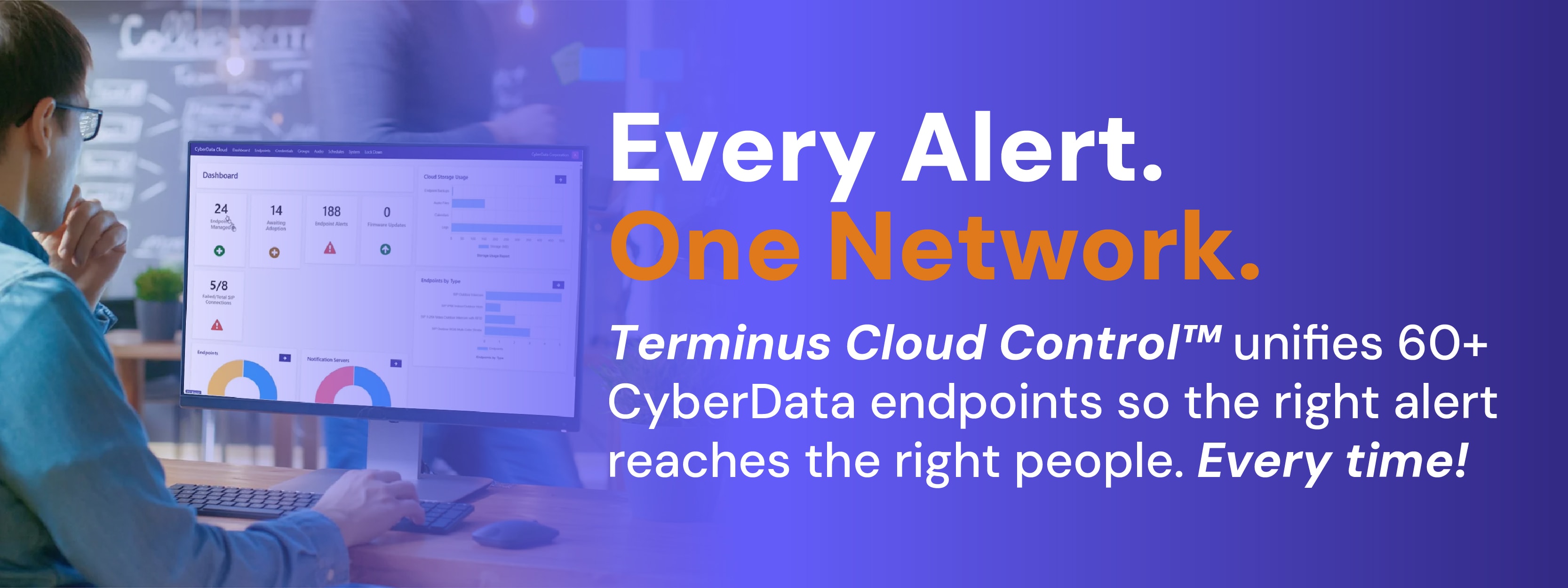
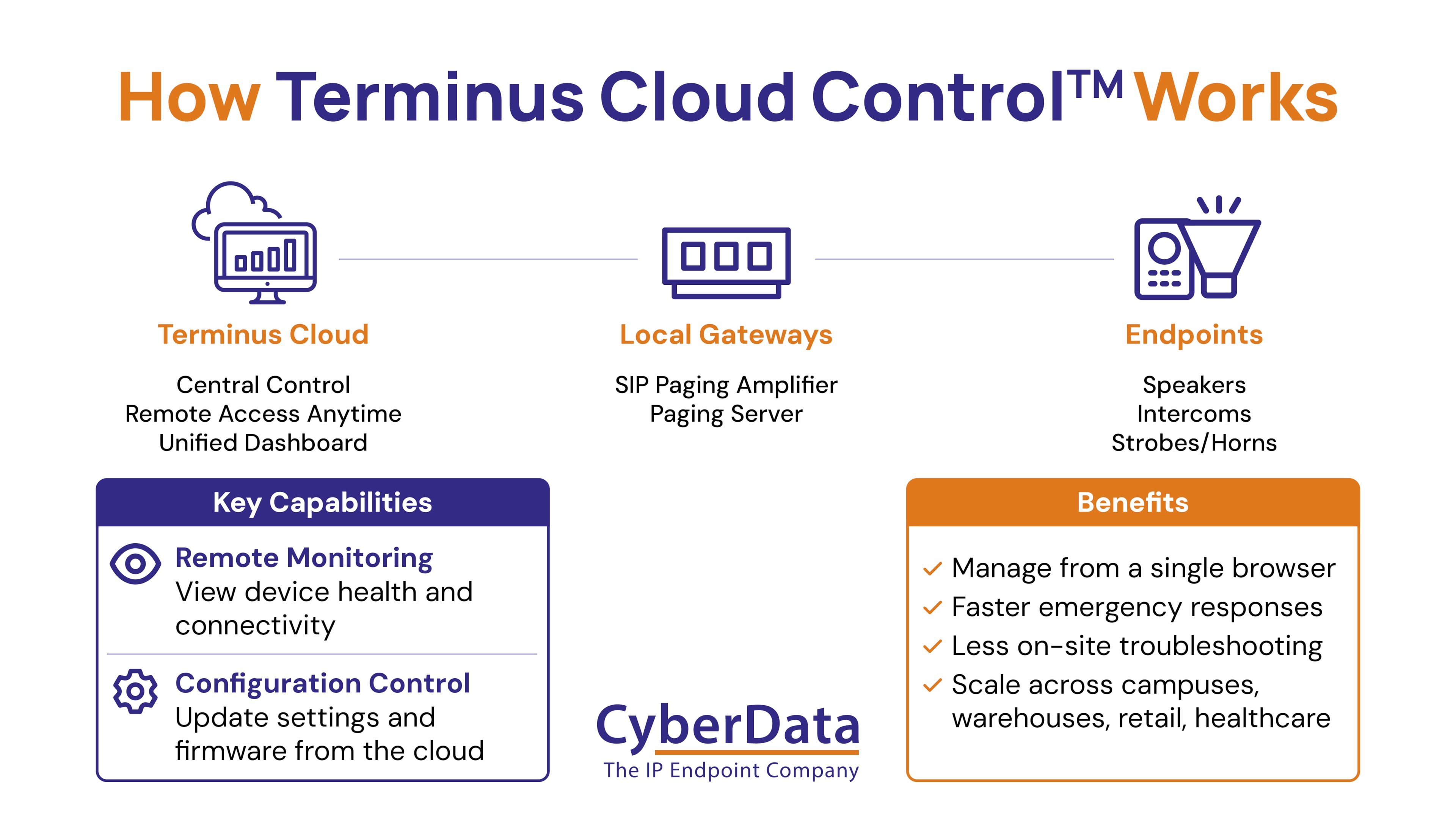
CyberData’s Terminus Cloud Control™ was built to exactly meet the needs of this model. It centralizes emergency and non-emergency notifications, device management, proactive diagnostics, and reporting for CyberData SIP endpoints like speakers, intercoms, and alert buttons.
When you work in education, retail, warehousing, and manufacturing, that means one workflow instead of a patchwork of amps, relays, and manual steps.
Why this type of communication software matters now
Enterprises are dealing with:
-
Distributed facilities and remote teams
-
Stricter safety expectations, including Alyssa’s Law and Silent Panic Alert Technology (SPAT) conversations in schools
-
Pressure to do more with existing infrastructure and budgets
That is why platforms that unify alerts, hardware, and management are quickly replacing standalone paging or software-only tools. CyberData’s roadmap pushes precisely this direction: hardware-aware SaaS with cloud intelligence layered on top of purpose-built SIP endpoints.
Key Criteria When Evaluating Notification Platforms
Here is a simple comparison table you can use when building your shortlist.
|
Criteria |
What it really means |
Questions to ask vendors |
|
Reliability and warranty |
Uptime, hardware durability, and clear support if something breaks |
What is the hardware warranty term? Is support included for the lifetime of the product, or is it an add-on? |
|
Centralized management |
One dashboard to send alerts, manage schedules, and oversee devices |
Can I control every site and every zone from a single browser login? How many logins does my team actually need? |
|
Multi-site scalability |
Ability to grow from a handful of buildings to hundreds without a redesign |
Are there limits on locations, zones, or devices? What happens if we double the endpoints in three years? |
|
Hybrid analog-to-IP migration |
Support for both legacy 25V/70V and modern SIP/IP devices |
Can we reuse our existing speakers with a hybrid amplifier, or do we have to rip and replace? |
|
Device diagnostics and monitoring |
Seeing issues before they become outages |
Does the platform show per-device status, temperature, and events? Can it alert IT when something goes offline? |
|
Cloud firmware updates |
Ability to patch and improve devices without visiting every site |
Can we push firmware and configuration updates to groups of devices directly from the cloud? |
|
Integrations |
How well it plays with phones, alarms, security, and business systems |
Does it integrate with our existing IP PBX, access control, cameras, or IoT sensors? |
|
Design help and partner support |
Real humans helping you architect the system |
Does the vendor offer free design services and pre-sales engineering support, or do we need to handle this ourselves? |
|
Total cost of ownership |
Budget over 5 to 10 years, not just the first invoice |
Is there a 5-year warranty, predictable software pricing, and a clear RMA path that keeps operations running? |
Use this as your interview cheat sheet with every vendor that’s in the mix.
The Importance of Centralized Business Communication Software and Management Across Multiple Locations
If you’re responsible for a school district, a warehouse, a manufacturing facility, or a multi-store brand, the confidence in knowing that if you send something once, it’ll reach everywhere is priceless. But that’s the whole idea behind an enterprise notification platform.
Without centralized control, you’ll often experience:
-
Different alert scripts and tones from site to site
-
Missed or delayed pages because someone dialed the wrong code
-
No reliable log showing who received what and when
Terminus Cloud Control™ removes points of friction to centralize emergency and routine notifications and device management across virtually unlimited sites and endpoints. IT and operations teams manage zones, priorities, and schedules from one interface instead of jumping between multiple server logins and vendor-specific GUIs.
-
In retail, for example, HQ can schedule a weekend promotion announcement or a severe-weather safety message across every store at once. Local managers can still send store-specific pages within clear guardrails.
-
In education, district staff can trigger lockdown or shelter-in-place workflows from the browser while each school maintains its own bell schedules and local announcements.

Why Device Diagnostics and Health Monitoring Matter
A speaker that quietly fails is worse than no speaker at all. You get the false sense of security knowing you have something up there, then when it's needed most, that security is ripped away from you because it’s failed at some point. Your system looks complete on paper, but in a real event, a whole zone goes silent, and there’s nothing but crickets.
That is why device-level diagnostics and health monitoring should be nonnegotiable in your enterprise communication platform.
With a cloud-connected notification brain like Terminus, organizations can:
-
See real-time status for each CyberData endpoint
-
Receive alerts for status changes, temperature issues, or connectivity loss
-
Review historical health events per device or per site
-
Push configuration fixes and firmware updates to affected groups
This turns your notification platform into an early warning system for the infrastructure itself, not just for people. Enterprises that have adopted centralized diagnostics report fewer emergency maintenance truck rolls and more predictable uptime.
Pair that with CyberData’s new 5-year warranty and proven RMA path, and you get both proactive and reactive safety nets for long multi-site rollouts.
Integration Requirements for an Enterprise Internal Communication Platform
Your notification platform can’t live in a vacuum. For it to perform to the best of its abilities, it has to work with:
-
The IP phone system that the staff already uses
-
Existing analog 25V/70V speakers in ceilings and hallways
-
Access control, cameras, and alarm panels
-
Business systems that may trigger alerts, such as POS or industrial controls
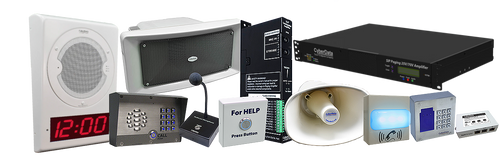
CyberData’s catalog of more than 60 SIP speakers, intercoms, alert buttons, and the SIP 25V/70V +4 Hybrid Amplifier was specifically built to bridge legacy analog speakers with VoIP networks.
That hybrid approach lets enterprises:
-
Save money and still use working analog speakers and wiring
-
Add SIP endpoints only where you need smarter zoning or visual strobes
-
Feed hundreds of speakers from a single PoE-powered hybrid amplifier
-
Join IP multicast groups for site-wide announcements without new cabling
On the software side, Terminus is designed as an open, hardware-aware cloud platform. It can connect to existing security, facilities, and business systems while maintaining native control over CyberData endpoints.
How Terminus Cloud Control Meets Enterprise-Level Expectations
Here is how Terminus lines up against the criteria we laid out earlier:
|
Need |
How Terminus Cloud Control responds |
|
Centralized notification management |
One cloud dashboard for emergency alerts, routine paging/intercom, bell schedules, and automations across sites |
|
Emergency + routine communication |
Lockdowns, severe weather, safety reminders, and day-to-day announcements share the same interface and templates |
|
Proactive device monitoring |
Real-time device health, diagnostics, and alerts for CyberData endpoints, plus centralized logs for audits |
|
Cloud-based firmware and config |
Firmware updates, configuration changes, and policy enforcement can be applied from the cloud by device group or site |
|
Multi-site visibility |
Role-based access gives districts, plant networks, or retail chains a single view of every campus, store, or building |
|
Hardware-aware SaaS |
Terminus knows the CyberData endpoints it controls, which gives it richer telemetry than software-only competitors |
Add CyberData’s Free Design Services into the mix, and you’re not guessing how many devices or which models you need. You can upload floor plans and receive device placement, a bill of materials, and network diagrams at no cost.
Ecosystem Matters: Why Hardware + Cloud Beat Software-Only
Many notification platforms are pure software. They still rely on third-party hardware that they do not manufacture or directly manage. That usually means:
-
Multiple support numbers when things go wrong
-
Limited visibility into device health
-
Warranty terms that vary per vendor
-
Higher integration and maintenance effort over time
At CyberData, we take a different route because it’s better for everyone. We deliver a unified ecosystem:
-
50-year U.S. engineering heritage and TAA-compliant hardware
-
60+ SIP endpoints and a SIP 25V/70V +4 Hybrid Amplifier for hybrid rollouts
-
Terminus Cloud Control™ is the central brain
-
An industry-leading 5-year warranty across the IP portfolio
-
New lower prices that make enterprise-grade safety more accessible
For partners like VARs and MSPs, this ecosystem is supported by a team that leans into projects with free design services, pre-sales engineering, and lifetime technical support.
A Simple Checklist for Your Enterprise Notification Platform Shortlist
Use this quick checklist as you compare options:
-
Platform fit: Does the platform centralize emergency alerts, routine paging/intercom, schedules, and device management in one UI? Can it scale from a few buildings to hundreds without changing architectures?
-
Infrastructure strategy: Can we keep working with 25V/70V speakers via a hybrid amplifier and add SIP endpoints where needed? Does it support our IP PBX, security systems, and future automation ideas?
-
Reliability and lifecycle: Is there at least a 5-year warranty on hardware? Do we get real-time device health, cloud firmware updates, and a clear RMA process?
-
Support and design help: Will the vendor or its partners help design the system, review floor plans, and join customer calls when needed? Is training and documentation included so your team is not starting from scratch?
-
People and process: Do you have a trusted business communication system integrator who understands your sites and day-to-day operations? We have a network of distribution and installation partners that specialize in simplifying complex voice, cabling, and paging environments for overloaded IT and operations leaders.
Bringing All Your Business Communications Platforms Together
Treating and selecting an enterprise notification platform based solely as a technical decision can cost you because it’s so much more. It’s a safety hub, operations, and trust decision.
A strong candidate will:
-
Standardize how your organization talks to every building, classroom, aisle, and production line
-
Protect existing investments by bridging analog and IP
-
Give IT real visibility into system health before an incident tests it
-
Back everything with a long warranty, proven support, and clear design guidance
Terminus Cloud Control™, paired with CyberData’s SIP endpoints and hybrid amplifiers, gives enterprises a practical, scalable enterprise communication platform that unifies alerts, hardware, and management in one dependable ecosystem.
When you are ready to shortlist platforms, use the criteria in this guide, loop in a trusted local partner, and ask one simple question of every vendor:
“Will this system still make sense for us in five years, across every site, without guesswork or scrambling?”
If the honest answer is anything but yes, keep looking. And if you have any other questions, we’d be happy to point you in the right direction. Contact us today!